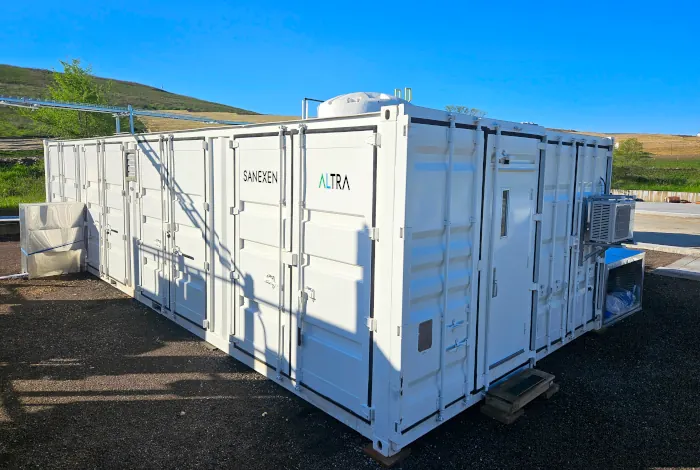
In Rosemount, a large-scale treatment facility has already processed more than 76 million liters of leachate.
Treating PFAS Using the Natural Properties of Air Bubbles
PFAS constitute a vast family of chemicals found in various types of contaminated water. Their presence in leachate—water that has percolated through waste at a landfill site—poses a particular challenge because of its complex composition and high levels of contaminants
To address this challenge, SANEXEN has developed the ALTRA technology, a treatment solution based on foam fractionation. After several years of research, laboratory testing, and field pilot projects, this technology is now being deployed on a large scale.
How Does Foam Fractionation Work?
The process takes advantage of a specific property of PFAS: these molecules tend to accumulate on the surface of water and air bubbles.
Fine bubbles are injected at the bottom of a water column. As they rise, they capture some of the PFAS and carry it to the surface, where a concentrated foam forms. The foam is then removed, separating the contaminants from a much larger volume of water.
It is important to note that this step does not destroy the PFAS. It concentrates them into a small volume of liquid, which can then be managed using an appropriate method, such as thermal treatment, an oxidation process, encapsulation, or a specialized disposal pathway.
Over 76 Million Litres Treated
An ALTRA unit has been in operation since early 2024 at the Rosemount landfill site in Minnesota. Designed for continuous operation, it has a capacity of approximately 273,000 litres per day.
In nearly two years, the unit has treated more than 76 million litres of leachate. The data collected shows that foam fractionation is particularly effective at removing long-chain PFAS: the removal rates observed generally range from 85% to 95% and can, under certain conditions, exceed 99%.
Short-chain PFAS, however, remain more difficult to capture. They account for 50% to 80% of the PFAS detected in certain leachates. Optimization efforts are therefore underway to further improve their processing.
A Solution Tailored to Each Site
Experience has shown that there is no one-size-fits-all solution. The composition of the leachate, its acidity, its alkalinity, and the nature of the PFAS present can influence foam formation and process performance.
That is why every project begins with thorough water characterization. Laboratory tests assess treatment feasibility, after which a pilot unit can be installed on-site. This step confirms performance under actual site conditions and allows parameters to be adjusted before deploying a commercial unit.
SANEXEN’s research laboratory performs approximately 2,000 PFAS analyses per year to support these studies and continuously improve processes.
Technology Designed for Real-World Conditions
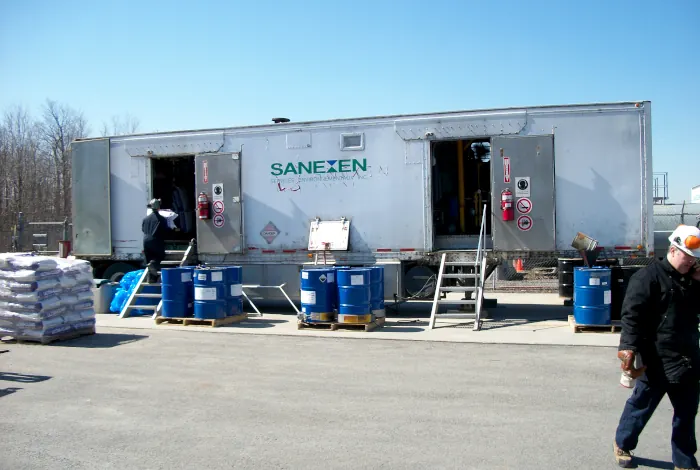
ALTRA units are modular, automated, and designed for continuous treatment. Their configuration facilitates installation, maintenance, and operational monitoring. They are also insulated and heated to enable operation in winter conditions.
Reducing PFAS in water is an essential first step. By combining foam concentration with complementary treatment and tailings management solutions, it becomes possible to implement a comprehensive approach tailored to the characteristics of each site.
This breakthrough illustrates how research, field testing, and engineering can transform a complex environmental challenge into a concrete solution.